
The Home of Pre-War London Talbots
The London Talbot Ambulance 23rd Jul 2025
The Talbot London Ambulance now runs, drives and stops for the first time in a number of years. It has now been returned to the London Ambulance Service Historic Collection after volunteers from the TOC sorted a raft of problems and mechanical issues to get the Ambulance back up and running. See next page.
Neil Lucas was instrumental in housing the Ambulance at his house whilst it was worked on, mainly by himself, but also by other TOC Members. Jim Catnach gave up a free day to come and donate his time and expertise, while Howard Day had the original vision several years ago to get the project started.
Craig Henty, the man in charge of the London Ambulance Service Historic Collection, said “I can’t thank the Talbot Owners’ Club enough for their help with this. Neil, it was amazing to drive her and learn about the upkeep. It’s so, so important to keep this historic vehicle in touch with the Talbot Owners’ Club and the public. Forever grateful.”
David Roxburgh

Recomissioning
The ambulance was brought on a trailer to my home on Wednesday 25 June.
It was no mean feat getting it into my drive as the towing vehicle and trailer were huge!
The ambulance had not run for 4 years, so I started to make observations on its condition on the Thursday afternoon and noted the following: the fuel tank is in good order with no leaks, there are no leaks in the water circulation, there are no oil leaks, the exhaust system seems good, there is oil in the engine, gearbox and rear axle to the correct levels.
Looking inside the dynastart, all brushes have quite even wear with very little dusting inside, so I left well alone. Some rewiring has been carried out over the years and more should be done if the ambulance is going to have more than very occasional use. I fitted two new 12-volt batteries as I knew the old ones were defective.
Knowing the ambulance had a problem pumping fuel to the carburettor, I fitted an electric fuel pump and plastic filter to sit on top of the fuel tank. Connecting a small battery enabled it to start pumping, which showed me where the leaks were. I replaced the fibre gaskets and rechecked the system. I also noticed the fuel pipe from the mechanical pump to the carb was of too small diameter so I replaced it with an original second hand spare one.
Before trying to start her up, I knew it had a slow running problem, so I fitted my own spare carburettor bowl which I knew was in good order.
When the time came to push the start button I found no ignition working but, by replacing the 35-amp fuse, it was rectified. On starting her, she fired up, but would only run at high revs. Water was circulating properly and the radiator heated up normally.
On Sunday 29 June, Jim Catnach came over to assist me and more work was done, particularly regarding the slow running issue. The fuel in the tank had deteriorated over time and adjustments were required to the slow running on the carburettor. With the octane booster and carb adjustment, the slow running improved dramatically. However, the engine seemed quite noisy and, after a lot of checking and deliberation, ruling out noise from the fan and water pump, it seemed the front bearing of the dynastart was the problem. After extracting the remains of a broken grease nipple, and fitting a new one, regreasing the dynastart has substantially reduced the noise level.
I have greased the few points where grease nipples are evident and added new grease to the water pump brass greaser unit. I have examined the distributor, cleaned inside, oiled the centre cam, and then left well alone. I have cleaned out all the jets in the carb and refitted the original bowl.
The oils in the engine, gearbox and rear axle have all been drained and replenished with new oil. In replacing the engine oil, the oil filter broke in my hand trying to extract it and a brass/bronze replacement has been fitted. The electric fuel pump has been wired into the dashboard, so no more manual priming of the fuel system. The fuel in the tank has all been drained, and refilled with 3 gallons of new fuel, together with a preservative. I have checked tyre pressures, they are now 35psi front and 30psi rear. I have driven the ambulance around my drive, and she appears to run well.
On Wednesday 16 July I was joined by Ian Potts and Charlie Elliot and we checked the dynastart for charging and found it to be in order, lubricated the rear wheel backplate housings, applied black insulating tape to bare wires on bulkhead, retested and drove the ambulance, drained radiator and block, and refilled with Carplan Blue Star antifreeze.
Finally we fitted a Talbot Owners’ Club badge on badge bar in front of the radiator in agreement with the London Ambulance Trust, before it was collected on Wednesday 23 July.
Neil Lucas
THE TALBOT OWNERS CLUB MAGAZINE
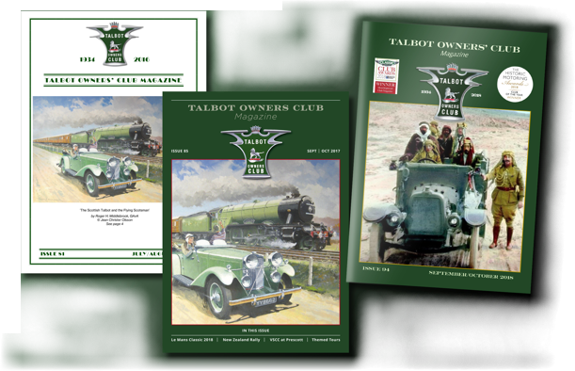
The Talbot Owners Club magazine is published bi-monthly and contains news, updates and informative articles. It is edited by club secretary David Roxburgh.
TALBOT OWNERS CLUB MEMBERSHIP
The essence of the Club is to ensure that members meet and enjoy themselves; the Club is open and democratic, dialogie is encouraged. It is for people of all ages who like Talbot cars and want to enjoy the company of like-minded people and also to support current Talbot involvement in historic competition.